





 [](https://travis-ci.org/kataras/iris) [](https://app.fossa.com/projects/git%2Bgithub.com%2Fkataras%2Firis?ref=badge_shield) [](http://goreportcard.com/report/kataras/iris) [](https://chat.iris-go.com) [](https://github.com/kataras/iris/tree/master/_examples/routing) [](https://github.com/kataras/iris/releases)
Iris is a fast, simple yet fully featured and very efficient web framework for Go. Routing is powered by the [muxie](https://github.com/kataras/muxie#philosophy) project.
Iris provides a beautifully expressive and easy to use foundation for your next website or API.
Iris offers a complete and decent solution and support for all gophers around the globe.
Learn what [others say about Iris](#support) and [star](https://github.com/kataras/iris/stargazers) this github repository to stay [up to date](https://facebook.com/iris.framework).
## Ghost? No More! Support as first class citizen
Have you bored of waiting weeks or months for someone to respond to your github issue? Yes, **me too**. If you choose Iris for your main backend development you will never be like a ghost again.
Iris is one of the few public github repositories that offers real support to individuals and collectivities, including companies. Unbeatable **free support**[*](#support) for three years and still counting. Navigate to the issues to see by yourself.
In these difficult and restless days **we stand beside you**. We **do not judge bad english writing**, no matter who you are, we will be here for you.
Check below the features and the hard work that we putted to improve how the internet is built. If you really like it and appreciate it, give a star to this github **repository for the public.**
## Benchmarks
### Iris vs .NET Core vs Expressjs
[](_benchmarks/README.md)
_Updated at: [Monday, 22 October 2018](_benchmarks/README.md)_
### Third-party
[](https://github.com/iris-contrib/third-party-benchmarks#full-table)
> Last updated at: 01 March of 2019. Click to the image to view all results. You can run this in your own hardware by following the [steps here](https://github.com/iris-contrib/third-party-benchmarks#usage).
## Philosophy
The Iris philosophy is to provide robust tooling for HTTP, making it a great solution for single page applications, web sites, hybrids, or public HTTP APIs. Keep note that, so far, iris is the fastest web framework ever created in terms of performance.
Iris does not force you to use any specific ORM or template engine. With support for the most used template engines, you can quickly craft the perfect application.
## Installation
The only requirement is the [Go Programming Language](https://golang.org/dl/), version 1.12 and above.
```sh
$ go get github.com/kataras/iris@v11.2.0
```
Or inside your `go.mod` file:
```sh
module your_project_name
go 1.12
require (
github.com/kataras/iris v11.2.0
)
```
## Quick start
```sh
# assume the following code in example.go file
$ cat example.go
```
```go
package main
import "github.com/kataras/iris"
func main() {
app := iris.Default()
app.Get("/ping", func(ctx iris.Context) {
ctx.JSON(iris.Map{
"message": "pong",
})
})
// listen and serve on http://0.0.0.0:8080.
app.Run(iris.Addr(":8080"))
}
```
```
# run example.go and visit http://0.0.0.0:8080/ping on browser
$ go run example.go
```
## API Examples
### Using Get, Post, Put, Patch, Delete and Options
```go
func main() {
// Creates an application with default middleware:
// logger and recovery (crash-free) middleware.
app := iris.Default()
app.Get("/someGet", getting)
app.Post("/somePost", posting)
app.Put("/somePut", putting)
app.Delete("/someDelete", deleting)
app.Patch("/somePatch", patching)
app.Head("/someHead", head)
app.Options("/someOptions", options)
app.Run(iris.Addr(":8080"))
}
```
### Parameters in path
| Param Type | Go Type | Validation | Retrieve Helper |
| -----------------|------|-------------|------|
| `:string` | string | anything (single path segment) | `Params().Get` |
| `:int` | int | -9223372036854775808 to 9223372036854775807 (x64) or -2147483648 to 2147483647 (x32), depends on the host arch | `Params().GetInt` |
| `:int8` | int8 | -128 to 127 | `Params().GetInt8` |
| `:int16` | int16 | -32768 to 32767 | `Params().GetInt16` |
| `:int32` | int32 | -2147483648 to 2147483647 | `Params().GetInt32` |
| `:int64` | int64 | -9223372036854775808 to 9223372036854775807 | `Params().GetInt64` |
| `:uint` | uint | 0 to 18446744073709551615 (x64) or 0 to 4294967295 (x32), depends on the host arch | `Params().GetUint` |
| `:uint8` | uint8 | 0 to 255 | `Params().GetUint8` |
| `:uint16` | uint16 | 0 to 65535 | `Params().GetUint16` |
| `:uint32` | uint32 | 0 to 4294967295 | `Params().GetUint32` |
| `:uint64` | uint64 | 0 to 18446744073709551615 | `Params().GetUint64` |
| `:bool` | bool | "1" or "t" or "T" or "TRUE" or "true" or "True" or "0" or "f" or "F" or "FALSE" or "false" or "False" | `Params().GetBool` |
| `:alphabetical` | string | lowercase or uppercase letters | `Params().Get` |
| `:file` | string | lowercase or uppercase letters, numbers, underscore (_), dash (-), point (.) and no spaces or other special characters that are not valid for filenames | `Params().Get` |
| `:path` | string | anything, can be separated by slashes (path segments) but should be the last part of the route path | `Params().Get` |
**Usage**:
```go
app.Get("/users/{id:uint64}", func(ctx iris.Context){
id := ctx.Params().GetUint64Default("id", 0)
// [...]
})
```
| Built-in Func | Param Types |
| -----------|---------------|
| `regexp`(expr string) | :string |
| `prefix`(prefix string) | :string |
| `suffix`(suffix string) | :string |
| `contains`(s string) | :string |
| `min`(minValue int or int8 or int16 or int32 or int64 or uint8 or uint16 or uint32 or uint64 or float32 or float64) | :string(char length), :int, :int8, :int16, :int32, :int64, :uint, :uint8, :uint16, :uint32, :uint64 |
| `max`(maxValue int or int8 or int16 or int32 or int64 or uint8 or uint16 or uint32 or uint64 or float32 or float64) | :string(char length), :int, :int8, :int16, :int32, :int64, :uint, :uint8, :uint16, :uint32, :uint64 |
| `range`(minValue, maxValue int or int8 or int16 or int32 or int64 or uint8 or uint16 or uint32 or uint64 or float32 or float64) | :int, :int8, :int16, :int32, :int64, :uint, :uint8, :uint16, :uint32, :uint64 |
**Usage**:
```go
app.Get("/profile/{name:alphabetical max(255)}", func(ctx iris.Context){
name := ctx.Params().Get("name")
// len(name) <=255 otherwise this route will fire 404 Not Found
// and this handler will not be executed at all.
})
```
**Do It Yourself**:
The `RegisterFunc` can accept any function that returns a `func(paramValue string) bool`.
Or just a `func(string) bool`.
If the validation fails then it will fire `404` or whatever status code the `else` keyword has.
```go
latLonExpr := "^-?[0-9]{1,3}(?:\\.[0-9]{1,10})?$"
latLonRegex, _ := regexp.Compile(latLonExpr)
// Register your custom argument-less macro function to the :string param type.
// MatchString is a type of func(string) bool, so we use it as it is.
app.Macros().Get("string").RegisterFunc("coordinate", latLonRegex.MatchString)
app.Get("/coordinates/{lat:string coordinate()}/{lon:string coordinate()}", func(ctx iris.Context) {
ctx.Writef("Lat: %s | Lon: %s", ctx.Params().Get("lat"), ctx.Params().Get("lon"))
})
```
Register your custom macro function which accepts two int arguments.
```go
app.Macros().Get("string").RegisterFunc("range", func(minLength, maxLength int) func(string) bool {
return func(paramValue string) bool {
return len(paramValue) >= minLength && len(paramValue) <= maxLength
}
})
app.Get("/limitchar/{name:string range(1,200) else 400}", func(ctx iris.Context) {
name := ctx.Params().Get("name")
ctx.Writef(`Hello %s | the name should be between 1 and 200 characters length
otherwise this handler will not be executed`, name)
})
```
Register your custom macro function which accepts a slice of strings `[...,...]`.
```go
app.Macros().Get("string").RegisterFunc("has", func(validNames []string) func(string) bool {
return func(paramValue string) bool {
for _, validName := range validNames {
if validName == paramValue {
return true
}
}
return false
}
})
app.Get("/static_validation/{name:string has([kataras,gerasimos,maropoulos])}", func(ctx iris.Context) {
name := ctx.Params().Get("name")
ctx.Writef(`Hello %s | the name should be "kataras" or "gerasimos" or "maropoulos"
otherwise this handler will not be executed`, name)
})
```
**Example Code**:
```go
func main() {
app := iris.Default()
// This handler will match /user/john but will not match neither /user/ or /user.
app.Get("/user/{name}", func(ctx iris.Context) {
name := ctx.Params().Get("name")
ctx.Writef("Hello %s", name)
})
// This handler will match /users/42
// but will not match /users/-1 because uint should be bigger than zero
// neither /users or /users/.
app.Get("/users/{id:uint64}", func(ctx iris.Context) {
id := ctx.Params().GetUint64Default("id", 0)
ctx.Writef("User with ID: %d", id)
})
// However, this one will match /user/john/send and also /user/john/everything/else/here
// but will not match /user/john neither /user/john/.
app.Post("/user/{name:string}/{action:path}", func(ctx iris.Context) {
name := ctx.Params().Get("name")
action := ctx.Params().Get("action")
message := name + " is " + action
ctx.WriteString(message)
})
app.Run(iris.Addr(":8080"))
}
```
> If parameter type is missing then defaults to `string`, therefore `{name:string}` and `{name}` do the same exactly thing.
> Learn more about path parameter's types by navigating [here](_examples/routing/dynamic-path/main.go#L31).
### Dependency Injection
The package [hero](hero) contains features for binding any object or functions that `handlers` can use, these are called dependencies.
With Iris you get truly safe bindings thanks to the [hero](_examples/hero) [package](hero). It is blazing-fast, near to raw handlers performance because Iris calculates everything before the server even goes online!
Below you will see some screenshots I prepared to facilitate understanding:
#### 1. Path Parameters - Built-in Dependencies

#### 2. Services - Static Dependencies

#### 3. Per-Request - Dynamic Dependencies

`hero funcs` are very easy to understand and when you start using them **you never go back**.
> With Iris you also get real and [blazing-fast](_benchmarks) [MVC support](_examples/mvc) which uses "hero" under the hoods.
### Querystring parameters
```go
func main() {
app := iris.Default()
// Query string parameters are parsed using the existing underlying request object.
// The request responds to a url matching: /welcome?firstname=Jane&lastname=Doe.
app.Get("/welcome", func(ctx iris.Context) {
firstname := ctx.URLParamDefault("firstname", "Guest")
// shortcut for ctx.Request().URL.Query().Get("lastname").
lastname := ctx.URLParam("lastname")
ctx.Writef("Hello %s %s", firstname, lastname)
})
app.Run(iris.Addr(":8080"))
}
```
### Multipart/Urlencoded Form
```go
func main() {
app := iris.Default()
app.Post("/form_post", func(ctx iris.Context) {
message := ctx.FormValue("message")
nick := ctx.FormValueDefault("nick", "anonymous")
ctx.JSON(iris.Map{
"status": "posted",
"message": message,
"nick": nick,
})
})
app.Run(iris.Addr(":8080"))
}
```
### Another example: query + post form
```
POST /post?id=1234&page=1 HTTP/1.1
Content-Type: application/x-www-form-urlencoded
name=manu&message=this_is_great
```
```go
func main() {
app := iris.Default()
app.Post("/post", func(ctx iris.Context) {
id := ctx.URLParam("id")
page := ctx.URLParamDefault("page", "0")
name := ctx.FormValue("name")
message := ctx.FormValue("message")
// or `ctx.PostValue` for POST, PUT & PATCH-only HTTP Methods.
app.Logger().Infof("id: %s; page: %s; name: %s; message: %s", id, page, name, message)
})
app.Run(iris.Addr(":8080"))
}
```
```
id: 1234; page: 1; name: manu; message: this_is_great
```
### Extract Referer
```go
package main
import (
"github.com/kataras/iris"
"github.com/kataras/iris/context"
)
func main() {
app := iris.New()
app.Get("/", func(ctx context.Context) /* or iris.Context, it's the same for Go 1.9+. */ {
// request header "referer" or url parameter "referer".
r := ctx.GetReferrer()
switch r.Type {
case context.ReferrerSearch:
ctx.Writef("Search %s: %s\n", r.Label, r.Query)
ctx.Writef("Google: %s\n", r.GoogleType)
case context.ReferrerSocial:
ctx.Writef("Social %s\n", r.Label)
case context.ReferrerIndirect:
ctx.Writef("Indirect: %s\n", r.URL)
}
})
app.Run(iris.Addr(":8080"))
}
```
How to `curl`:
```bash
curl http://localhost:8080?referer=https://twitter.com/Xinterio/status/1023566830974251008
curl http://localhost:8080?referer=https://www.google.com/search?q=Top+6+golang+web+frameworks&oq=Top+6+golang+web+frameworks
```
### Upload files
- [single file upload](_examples/http_request/upload-file/main.go)
- [multi file upload](_examples/http_request/upload-files)
```go
const maxSize = 5 << 20 // 5MB
func main() {
app := iris.Default()
app.Post("/upload", iris.LimitRequestBodySize(maxSize), func(ctx iris.Context) {
//
// UploadFormFiles
// uploads any number of incoming files ("multiple" property on the form input).
//
// The second, optional, argument
// can be used to change a file's name based on the request,
// at this example we will showcase how to use it
// by prefixing the uploaded file with the current user's ip.
ctx.UploadFormFiles("./uploads", beforeSave)
})
app.Run(iris.Addr(":8080"))
}
func beforeSave(ctx iris.Context, file *multipart.FileHeader) {
ip := ctx.RemoteAddr()
// make sure you format the ip in a way
// that can be used for a file name (simple case):
ip = strings.Replace(ip, ".", "_", -1)
ip = strings.Replace(ip, ":", "_", -1)
// you can use the time.Now, to prefix or suffix the files
// based on the current time as well, as an exercise.
// i.e unixTime := time.Now().Unix()
// prefix the Filename with the $IP-
// no need for more actions, internal uploader will use this
// name to save the file into the "./uploads" folder.
file.Filename = ip + "-" + file.Filename
}
```
How to `curl`:
```bash
curl -X POST http://localhost:8080/upload \
-F "files[]=@./myfile.zip" \
-F "files[]=@./mysecondfile.zip" \
-H "Content-Type: multipart/form-data"
```
### Grouping routes
```go
func main() {
app := iris.Default()
// Simple group: v1.
v1 := app.Party("/v1")
{
v1.Post("/login", loginEndpoint)
v1.Post("/submit", submitEndpoint)
v1.Post("/read", readEndpoint)
}
// Simple group: v2.
v2 := app.Party("/v2")
{
v2.Post("/login", loginEndpoint)
v2.Post("/submit", submitEndpoint)
v2.Post("/read", readEndpoint)
}
app.Run(iris.Addr(":8080"))
}
```
### Blank Iris without middleware by default
Use
```go
app := iris.New()
```
instead of
```go
// Default with the Logger and Recovery middleware already attached.
app := iris.Default()
```
### Using middleware
```go
import (
"github.com/kataras/iris"
"github.com/kataras/iris/middleware/recover"
"github.com/kataras/iris/middleware/logger"
)
func main() {
// Creates an application without any middleware by default.
app := iris.New()
// Recover middleware recovers from any panics and writes a 500 if there was one.
app.Use(recover.New())
requestLogger := logger.New(logger.Config{
// Status displays status code
Status: true,
// IP displays request's remote address
IP: true,
// Method displays the http method
Method: true,
// Path displays the request path
Path: true,
// Query appends the url query to the Path.
Query: true,
// if !empty then its contents derives from `ctx.Values().Get("logger_message")
// will be added to the logs.
MessageContextKeys: []string{"logger_message"},
// if !empty then its contents derives from `ctx.GetHeader("User-Agent")
MessageHeaderKeys: []string{"User-Agent"},
})
app.Use(requestLogger)
// Per route middleware, you can add as many as you desire.
app.Get("/benchmark", MyBenchLogger(), benchEndpoint)
// Authorization party /user.
// authorized := app.Party("/user", AuthRequired())
// exactly the same as:
authorized := app.Party("/user")
// per party middleware! in this case we use the custom created
// AuthRequired() middleware just in the "authorized" group/party.
authorized.Use(AuthRequired())
{
authorized.Post("/login", loginEndpoint)
authorized.Post("/submit", submitEndpoint)
authorized.Post("/read", readEndpoint)
// nested group: /user/testing
testing := authorized.Party("/testing")
testing.Get("/analytics", analyticsEndpoint)
}
// Listen and serve on http://0.0.0.0:8080
app.Run(iris.Addr(":8080"))
}
```
### How to write log file
```go
package main
import (
"os"
"time"
"github.com/kataras/iris"
)
// Get a filename based on the date, just for the sugar.
func todayFilename() string {
today := time.Now().Format("Jan 02 2006")
return today + ".txt"
}
func newLogFile() *os.File {
filename := todayFilename()
// Open the file, this will append to the today's file if server restarted.
f, err := os.OpenFile(filename, os.O_CREATE|os.O_WRONLY|os.O_APPEND, 0666)
if err != nil {
panic(err)
}
return f
}
func main() {
f := newLogFile()
defer f.Close()
app := iris.New()
// Attach the file as logger, remember, iris' app logger is just an io.Writer.
// Use the following code if you need to write the logs to file and console at the same time.
// app.Logger().SetOutput(io.MultiWriter(f, os.Stdout))
app.Logger().SetOutput(f)
app.Get("/ping", func(ctx iris.Context) {
// for the sake of simplicity, in order see the logs at the ./_today_.txt
ctx.Application().Logger().Infof("Request path: %s", ctx.Path())
ctx.WriteString("pong")
})
// Navigate to http://localhost:8080/ping
// and open the ./logs{TODAY}.txt file.
app.Run(
iris.Addr(":8080"),
iris.WithoutBanner,
iris.WithoutServerError(iris.ErrServerClosed),
)
}
```
### Model binding and validation
Iris uses [**go-playground/validator.v9**](https://github.com/go-playground/validator) for validation. Check the full docs on tags usage [here](http://godoc.org/gopkg.in/go-playground/validator.v9#hdr-Baked_In_Validators_and_Tags).
Example [detail code](_examples/http_request/read-json-struct-validation/main.go).
Note that you need to set the corresponding binding tag on all fields you want to bind. For example, when binding from JSON, set `json:"fieldname"`.
```go
package main
import (
"fmt"
"github.com/kataras/iris"
"gopkg.in/go-playground/validator.v9"
)
// User contains user information.
type User struct {
FirstName string `json:"fname"`
LastName string `json:"lname"`
Age uint8 `json:"age" validate:"gte=0,lte=130"`
Email string `json:"email" validate:"required,email"`
FavouriteColor string `json:"favColor" validate:"hexcolor|rgb|rgba"`
Addresses []*Address `json:"addresses" validate:"required,dive,required"`
}
// Address houses a users address information.
type Address struct {
Street string `json:"street" validate:"required"`
City string `json:"city" validate:"required"`
Planet string `json:"planet" validate:"required"`
Phone string `json:"phone" validate:"required"`
}
// Use a single instance of Validate, it caches struct info.
var validate *validator.Validate
func main() {
validate = validator.New()
// Register validation for 'User'
// NOTE: only have to register a non-pointer type for 'User', validator
// internally dereferences during it's type checks.
validate.RegisterStructValidation(UserStructLevelValidation, User{})
app := iris.New()
app.Post("/user", func(ctx iris.Context) {
var user User
if err := ctx.ReadJSON(&user); err != nil {
// Handle error.
}
// Returns InvalidValidationError for bad validation input,
// nil or ValidationErrors ( []FieldError )
err := validate.Struct(user)
if err != nil {
// This check is only needed when your code could produce
// an invalid value for validation such as interface with nil
// value most including myself do not usually have code like this.
if _, ok := err.(*validator.InvalidValidationError); ok {
ctx.StatusCode(iris.StatusInternalServerError)
ctx.WriteString(err.Error())
return
}
ctx.StatusCode(iris.StatusBadRequest)
for _, err := range err.(validator.ValidationErrors) {
fmt.Println()
fmt.Println(err.Namespace())
fmt.Println(err.Field())
fmt.Println(err.StructNamespace())
fmt.Println(err.StructField())
fmt.Println(err.Tag())
fmt.Println(err.ActualTag())
fmt.Println(err.Kind())
fmt.Println(err.Type())
fmt.Println(err.Value())
fmt.Println(err.Param())
fmt.Println()
}
return
}
// save user to database.
})
app.Run(iris.Addr(":8080"))
}
func UserStructLevelValidation(sl validator.StructLevel) {
user := sl.Current().Interface().(User)
if len(user.FirstName) == 0 && len(user.LastName) == 0 {
sl.ReportError(user.FirstName, "FirstName", "fname", "fnameorlname", "")
sl.ReportError(user.LastName, "LastName", "lname", "fnameorlname", "")
}
}
```
```json
{
"fname": "",
"lname": "",
"age": 45,
"email": "mail@example.com",
"favColor": "#000",
"addresses": [{
"street": "Eavesdown Docks",
"planet": "Persphone",
"phone": "none",
"city": "Unknown"
}]
}
```
### Websockets
```go
package main
import (
"fmt"
"github.com/kataras/iris"
"github.com/kataras/iris/websocket"
)
func main() {
app := iris.New()
app.Get("/", func(ctx iris.Context) {
ctx.ServeFile("websockets.html", false) // second parameter: enable gzip?
})
setupWebsocket(app)
// x2
// http://localhost:8080
// http://localhost:8080
// write something, press submit, see the result.
app.Run(iris.Addr(":8080"))
}
func setupWebsocket(app *iris.Application) {
// create our echo websocket server
ws := websocket.New(websocket.Config{
ReadBufferSize: 1024,
WriteBufferSize: 1024,
})
ws.OnConnection(handleConnection)
// register the server on an endpoint.
// see the inline javascript code in the websockets.html,
// this endpoint is used to connect to the server.
app.Get("/echo", ws.Handler())
// serve the javascript built-in client-side library,
// see websockets.html script tags, this path is used.
app.Any("/iris-ws.js", websocket.ClientHandler())
}
func handleConnection(c websocket.Connection) {
// Read events from browser
c.On("chat", func(msg string) {
// Print the message to the console, c.Context() is the iris's http context.
fmt.Printf("%s sent: %s\n", c.Context().RemoteAddr(), msg)
// Write message back to the client message owner with:
// c.Emit("chat", msg)
// Write message to all except this client with:
c.To(websocket.Broadcast).Emit("chat", msg)
})
}
```
**websockets.html**
```html
```
Navigate to the [_examples/websocket](_examples/websocket) folder for more.
### Cookies
> Are you looking about [http sessions instead?](_examples/sessions)
Let's write a simple application which will make use of the HTTP Cookies.
```sh
$ cat _examples/cookies/basic/main.go
```
```go
package main
import "github.com/kataras/iris"
func newApp() *iris.Application {
app := iris.New()
// Set A Cookie.
app.Get("/cookies/{name}/{value}", func(ctx iris.Context) {
name := ctx.Params().Get("name")
value := ctx.Params().Get("value")
ctx.SetCookieKV(name, value)
ctx.Writef("cookie added: %s = %s", name, value)
})
// Retrieve A Cookie.
app.Get("/cookies/{name}", func(ctx iris.Context) {
name := ctx.Params().Get("name")
value := ctx.GetCookie(name)
ctx.WriteString(value)
})
// Delete A Cookie.
app.Delete("/cookies/{name}", func(ctx iris.Context) {
name := ctx.Params().Get("name")
ctx.RemoveCookie(name)
ctx.Writef("cookie %s removed", name)
})
return app
}
func main() {
app := newApp()
// GET: http://localhost:8080/cookies/my_name/my_value
// GET: http://localhost:8080/cookies/my_name
// DELETE: http://localhost:8080/cookies/my_name
app.Run(iris.Addr(":8080"))
}
```
* Alternatively, use a regular `http.Cookie`: `ctx.SetCookie(&http.Cookie{...})`
* If you want to set custom the path: `ctx.SetCookieKV(name, value, iris.CookiePath("/custom/path/cookie/will/be/stored"))`.
* If you want to be available only to the current request path: `ctx.SetCookieKV(name, value, iris.CookieCleanPath /* or iris.CookiePath("") */)`
* `iris.CookieExpires(time.Duration)`
* `iris.CookieHTTPOnly(false)`
* `ctx.Request().Cookie(name)` is also available, it's the `net/http` approach
* Learn more about path parameter's types by clicking [here](_examples/routing/dynamic-path/main.go#L31).
### Testing
Iris offers an incredible support for the [httpexpect](https://github.com/gavv/httpexpect), a Testing Framework for web applications. However, you are able to use the standard Go's `net/http/httptest` package as well but in this example we will use the `kataras/iris/httptest`.
```go
package main
import (
"fmt"
"testing"
"github.com/kataras/iris/httptest"
)
// go test -v -run=TestCookiesBasic$
func TestCookiesBasic(t *testing.T) {
app := newApp()
e := httptest.New(t, app, httptest.URL("http://example.com"))
cookieName, cookieValue := "my_cookie_name", "my_cookie_value"
// Test Set A Cookie.
t1 := e.GET(fmt.Sprintf("/cookies/%s/%s", cookieName, cookieValue)).Expect().Status(httptest.StatusOK)
t1.Cookie(cookieName).Value().Equal(cookieValue) // validate cookie's existence, it should be there now.
t1.Body().Contains(cookieValue)
path := fmt.Sprintf("/cookies/%s", cookieName)
// Test Retrieve A Cookie.
t2 := e.GET(path).Expect().Status(httptest.StatusOK)
t2.Body().Equal(cookieValue)
// Test Remove A Cookie.
t3 := e.DELETE(path).Expect().Status(httptest.StatusOK)
t3.Body().Contains(cookieName)
t4 := e.GET(path).Expect().Status(httptest.StatusOK)
t4.Cookies().Empty()
t4.Body().Empty()
}
```
## Learn
First of all, the most correct way to begin with a web framework is to learn the basics of the programming language and the standard `http` capabilities, if your web application is a very simple personal project without performance and maintainability requirements you may want to proceed just with the standard packages. After that follow the guidelines:
- Navigate through **100+1** **[examples](_examples)** and some [iris starter kits](#iris-starter-kits) we crafted for you
- Read the [godocs](https://godoc.org/github.com/kataras/iris) for any details
- Prepare a cup of coffee or tea, whatever pleases you the most, and read some [articles](#articles) we found for you
- Run some of our [starter kits](#iris-starter-kits)
### Middleware
Iris has a great collection of handlers[[1]](middleware/)[[2]](https://github.com/iris-contrib/middleware) that you can use side by side with your web apps. However you are not limited to them - you are free to use any third-party middleware that is compatible with the [net/http](https://golang.org/pkg/net/http/) package, [_examples/convert-handlers](_examples/convert-handlers) will show you the way.
Iris, unlike others, is 100% compatible with the standards and that's why the majority of the big companies that adapt Go to their workflow, like a very famous US Television Network, trust Iris; it's up-to-date and it will be always aligned with the std `net/http` package which is modernized by the Go Authors on each new release of the Go Programming Language.
### Video Courses
| Description | Link | Author | Year |
| -----------|-------------|-------------|-----|
| Installing Iris | https://bit.ly/2KhgB1J | WarnabiruTV | 2018 |
| Iris & Mongo DB Complete | https://bit.ly/2IcXZOu | Musobar Media | 2018 |
| Quick Start with Iris | https://bit.ly/2wQIrJw | J-Secur1ty | **2019** |
| Getting Started with Iris | https://bit.ly/2XGafMv | stephgdesign | 2018 |
### Articles
* [A URL Shortener Service using Go, Iris and Bolt (Updated)](https://bit.ly/2KeP6pE)
* [CRUD REST API in Iris (a framework for golang)](https://bit.ly/2X9EsXl)
* [A Todo MVC Application using Iris and Vue.js](https://bit.ly/2KgEarI)
* [A Hasura starter project with a ready to deploy Golang hello-world web app with IRIS](https://bit.ly/2Kfdsjf)
* [Top 6 web frameworks for Go as of 2017](https://bit.ly/2wMi9YY)
* [Iris Go Framework + MongoDB](https://bit.ly/2WDOsZF)
* [How to build a file upload form using DropzoneJS and Go](https://bit.ly/2IdigmZ)
* [How to display existing files on server using DropzoneJS and Go](https://bit.ly/2IBQ7Vv)
* [Iris, a modular web framework](https://bit.ly/2KHm6q0)
* [Go vs .NET Core in terms of HTTP performance](https://bit.ly/2Kh7ezl)
* [Iris Go vs .NET Core Kestrel in terms of HTTP performance](https://bit.ly/2WBqucu)
* [How to Turn an Android Device into a Web Server](https://bit.ly/2Icl5EM)
## Iris starter kits
1. [snowlyg/IrisApiProject: Iris + gorm + jwt + sqlite3](https://bit.ly/2IaL1R6) **NEW-Chinese**
2. [yz124/superstar: Iris + xorm to implement the star library](https://bit.ly/2WF4ZfK) **NEW-Chinese**
3. [jebzmos4/Iris-golang: A basic CRUD API in golang with Iris](https://bit.ly/2XFyESo)
4. [gauravtiwari/go_iris_app: A basic web app built in Iris for Go](https://bit.ly/2XFVYQ4)
5. [A mini social-network created with the awesome Iris💖💖](https://bit.ly/2KJvZn7)
6. [Iris isomorphic react/hot reloadable/redux/css-modules starter kit](https://bit.ly/2ReoGoH)
7. [ionutvilie/react-ts: Demo project with react using typescript and Iris](https://bit.ly/2wZA52B)
8. [Self-hosted Localization Management Platform built with Iris and Angular](https://bit.ly/2F9iYzM)
9. [Iris + Docker and Kubernetes](https://bit.ly/2WGlXKL)
10. [nanobox.io: Quickstart for Iris with Nanobox](https://bit.ly/2wMkdjG)
11. [hasura.io: A Hasura starter project with a ready to deploy Golang hello-world web app with IRIS](https://bit.ly/2Kfdsjf)
## Support
- [HISTORY](HISTORY.md#fr-11-january-2019--v1111) file is your best friend, it contains information about the latest features and changes
- Did you happen to find a bug? Post it at [github issues](https://github.com/kataras/iris/issues)
- Do you have any questions or need to speak with someone experienced to solve a problem at real-time? Join us to the [community chat](https://chat.iris-go.com)
- Complete our form-based user experience report by clicking [here](https://docs.google.com/forms/d/e/1FAIpQLSdCxZXPANg_xHWil4kVAdhmh7EBBHQZ_4_xSZVDL-oCC_z5pA/viewform?usp=sf_link)
- Do you like the framework? Tweet something about it! The People have spoken:
[](https://travis-ci.org/kataras/iris) [](https://app.fossa.com/projects/git%2Bgithub.com%2Fkataras%2Firis?ref=badge_shield) [](http://goreportcard.com/report/kataras/iris) [](https://chat.iris-go.com) [](https://github.com/kataras/iris/tree/master/_examples/routing) [](https://github.com/kataras/iris/releases)
Iris is a fast, simple yet fully featured and very efficient web framework for Go. Routing is powered by the [muxie](https://github.com/kataras/muxie#philosophy) project.
Iris provides a beautifully expressive and easy to use foundation for your next website or API.
Iris offers a complete and decent solution and support for all gophers around the globe.
Learn what [others say about Iris](#support) and [star](https://github.com/kataras/iris/stargazers) this github repository to stay [up to date](https://facebook.com/iris.framework).
## Ghost? No More! Support as first class citizen
Have you bored of waiting weeks or months for someone to respond to your github issue? Yes, **me too**. If you choose Iris for your main backend development you will never be like a ghost again.
Iris is one of the few public github repositories that offers real support to individuals and collectivities, including companies. Unbeatable **free support**[*](#support) for three years and still counting. Navigate to the issues to see by yourself.
In these difficult and restless days **we stand beside you**. We **do not judge bad english writing**, no matter who you are, we will be here for you.
Check below the features and the hard work that we putted to improve how the internet is built. If you really like it and appreciate it, give a star to this github **repository for the public.**
## Benchmarks
### Iris vs .NET Core vs Expressjs
[](_benchmarks/README.md)
_Updated at: [Monday, 22 October 2018](_benchmarks/README.md)_
### Third-party
[](https://github.com/iris-contrib/third-party-benchmarks#full-table)
> Last updated at: 01 March of 2019. Click to the image to view all results. You can run this in your own hardware by following the [steps here](https://github.com/iris-contrib/third-party-benchmarks#usage).
## Philosophy
The Iris philosophy is to provide robust tooling for HTTP, making it a great solution for single page applications, web sites, hybrids, or public HTTP APIs. Keep note that, so far, iris is the fastest web framework ever created in terms of performance.
Iris does not force you to use any specific ORM or template engine. With support for the most used template engines, you can quickly craft the perfect application.
## Installation
The only requirement is the [Go Programming Language](https://golang.org/dl/), version 1.12 and above.
```sh
$ go get github.com/kataras/iris@v11.2.0
```
Or inside your `go.mod` file:
```sh
module your_project_name
go 1.12
require (
github.com/kataras/iris v11.2.0
)
```
## Quick start
```sh
# assume the following code in example.go file
$ cat example.go
```
```go
package main
import "github.com/kataras/iris"
func main() {
app := iris.Default()
app.Get("/ping", func(ctx iris.Context) {
ctx.JSON(iris.Map{
"message": "pong",
})
})
// listen and serve on http://0.0.0.0:8080.
app.Run(iris.Addr(":8080"))
}
```
```
# run example.go and visit http://0.0.0.0:8080/ping on browser
$ go run example.go
```
## API Examples
### Using Get, Post, Put, Patch, Delete and Options
```go
func main() {
// Creates an application with default middleware:
// logger and recovery (crash-free) middleware.
app := iris.Default()
app.Get("/someGet", getting)
app.Post("/somePost", posting)
app.Put("/somePut", putting)
app.Delete("/someDelete", deleting)
app.Patch("/somePatch", patching)
app.Head("/someHead", head)
app.Options("/someOptions", options)
app.Run(iris.Addr(":8080"))
}
```
### Parameters in path
| Param Type | Go Type | Validation | Retrieve Helper |
| -----------------|------|-------------|------|
| `:string` | string | anything (single path segment) | `Params().Get` |
| `:int` | int | -9223372036854775808 to 9223372036854775807 (x64) or -2147483648 to 2147483647 (x32), depends on the host arch | `Params().GetInt` |
| `:int8` | int8 | -128 to 127 | `Params().GetInt8` |
| `:int16` | int16 | -32768 to 32767 | `Params().GetInt16` |
| `:int32` | int32 | -2147483648 to 2147483647 | `Params().GetInt32` |
| `:int64` | int64 | -9223372036854775808 to 9223372036854775807 | `Params().GetInt64` |
| `:uint` | uint | 0 to 18446744073709551615 (x64) or 0 to 4294967295 (x32), depends on the host arch | `Params().GetUint` |
| `:uint8` | uint8 | 0 to 255 | `Params().GetUint8` |
| `:uint16` | uint16 | 0 to 65535 | `Params().GetUint16` |
| `:uint32` | uint32 | 0 to 4294967295 | `Params().GetUint32` |
| `:uint64` | uint64 | 0 to 18446744073709551615 | `Params().GetUint64` |
| `:bool` | bool | "1" or "t" or "T" or "TRUE" or "true" or "True" or "0" or "f" or "F" or "FALSE" or "false" or "False" | `Params().GetBool` |
| `:alphabetical` | string | lowercase or uppercase letters | `Params().Get` |
| `:file` | string | lowercase or uppercase letters, numbers, underscore (_), dash (-), point (.) and no spaces or other special characters that are not valid for filenames | `Params().Get` |
| `:path` | string | anything, can be separated by slashes (path segments) but should be the last part of the route path | `Params().Get` |
**Usage**:
```go
app.Get("/users/{id:uint64}", func(ctx iris.Context){
id := ctx.Params().GetUint64Default("id", 0)
// [...]
})
```
| Built-in Func | Param Types |
| -----------|---------------|
| `regexp`(expr string) | :string |
| `prefix`(prefix string) | :string |
| `suffix`(suffix string) | :string |
| `contains`(s string) | :string |
| `min`(minValue int or int8 or int16 or int32 or int64 or uint8 or uint16 or uint32 or uint64 or float32 or float64) | :string(char length), :int, :int8, :int16, :int32, :int64, :uint, :uint8, :uint16, :uint32, :uint64 |
| `max`(maxValue int or int8 or int16 or int32 or int64 or uint8 or uint16 or uint32 or uint64 or float32 or float64) | :string(char length), :int, :int8, :int16, :int32, :int64, :uint, :uint8, :uint16, :uint32, :uint64 |
| `range`(minValue, maxValue int or int8 or int16 or int32 or int64 or uint8 or uint16 or uint32 or uint64 or float32 or float64) | :int, :int8, :int16, :int32, :int64, :uint, :uint8, :uint16, :uint32, :uint64 |
**Usage**:
```go
app.Get("/profile/{name:alphabetical max(255)}", func(ctx iris.Context){
name := ctx.Params().Get("name")
// len(name) <=255 otherwise this route will fire 404 Not Found
// and this handler will not be executed at all.
})
```
**Do It Yourself**:
The `RegisterFunc` can accept any function that returns a `func(paramValue string) bool`.
Or just a `func(string) bool`.
If the validation fails then it will fire `404` or whatever status code the `else` keyword has.
```go
latLonExpr := "^-?[0-9]{1,3}(?:\\.[0-9]{1,10})?$"
latLonRegex, _ := regexp.Compile(latLonExpr)
// Register your custom argument-less macro function to the :string param type.
// MatchString is a type of func(string) bool, so we use it as it is.
app.Macros().Get("string").RegisterFunc("coordinate", latLonRegex.MatchString)
app.Get("/coordinates/{lat:string coordinate()}/{lon:string coordinate()}", func(ctx iris.Context) {
ctx.Writef("Lat: %s | Lon: %s", ctx.Params().Get("lat"), ctx.Params().Get("lon"))
})
```
Register your custom macro function which accepts two int arguments.
```go
app.Macros().Get("string").RegisterFunc("range", func(minLength, maxLength int) func(string) bool {
return func(paramValue string) bool {
return len(paramValue) >= minLength && len(paramValue) <= maxLength
}
})
app.Get("/limitchar/{name:string range(1,200) else 400}", func(ctx iris.Context) {
name := ctx.Params().Get("name")
ctx.Writef(`Hello %s | the name should be between 1 and 200 characters length
otherwise this handler will not be executed`, name)
})
```
Register your custom macro function which accepts a slice of strings `[...,...]`.
```go
app.Macros().Get("string").RegisterFunc("has", func(validNames []string) func(string) bool {
return func(paramValue string) bool {
for _, validName := range validNames {
if validName == paramValue {
return true
}
}
return false
}
})
app.Get("/static_validation/{name:string has([kataras,gerasimos,maropoulos])}", func(ctx iris.Context) {
name := ctx.Params().Get("name")
ctx.Writef(`Hello %s | the name should be "kataras" or "gerasimos" or "maropoulos"
otherwise this handler will not be executed`, name)
})
```
**Example Code**:
```go
func main() {
app := iris.Default()
// This handler will match /user/john but will not match neither /user/ or /user.
app.Get("/user/{name}", func(ctx iris.Context) {
name := ctx.Params().Get("name")
ctx.Writef("Hello %s", name)
})
// This handler will match /users/42
// but will not match /users/-1 because uint should be bigger than zero
// neither /users or /users/.
app.Get("/users/{id:uint64}", func(ctx iris.Context) {
id := ctx.Params().GetUint64Default("id", 0)
ctx.Writef("User with ID: %d", id)
})
// However, this one will match /user/john/send and also /user/john/everything/else/here
// but will not match /user/john neither /user/john/.
app.Post("/user/{name:string}/{action:path}", func(ctx iris.Context) {
name := ctx.Params().Get("name")
action := ctx.Params().Get("action")
message := name + " is " + action
ctx.WriteString(message)
})
app.Run(iris.Addr(":8080"))
}
```
> If parameter type is missing then defaults to `string`, therefore `{name:string}` and `{name}` do the same exactly thing.
> Learn more about path parameter's types by navigating [here](_examples/routing/dynamic-path/main.go#L31).
### Dependency Injection
The package [hero](hero) contains features for binding any object or functions that `handlers` can use, these are called dependencies.
With Iris you get truly safe bindings thanks to the [hero](_examples/hero) [package](hero). It is blazing-fast, near to raw handlers performance because Iris calculates everything before the server even goes online!
Below you will see some screenshots I prepared to facilitate understanding:
#### 1. Path Parameters - Built-in Dependencies

#### 2. Services - Static Dependencies

#### 3. Per-Request - Dynamic Dependencies

`hero funcs` are very easy to understand and when you start using them **you never go back**.
> With Iris you also get real and [blazing-fast](_benchmarks) [MVC support](_examples/mvc) which uses "hero" under the hoods.
### Querystring parameters
```go
func main() {
app := iris.Default()
// Query string parameters are parsed using the existing underlying request object.
// The request responds to a url matching: /welcome?firstname=Jane&lastname=Doe.
app.Get("/welcome", func(ctx iris.Context) {
firstname := ctx.URLParamDefault("firstname", "Guest")
// shortcut for ctx.Request().URL.Query().Get("lastname").
lastname := ctx.URLParam("lastname")
ctx.Writef("Hello %s %s", firstname, lastname)
})
app.Run(iris.Addr(":8080"))
}
```
### Multipart/Urlencoded Form
```go
func main() {
app := iris.Default()
app.Post("/form_post", func(ctx iris.Context) {
message := ctx.FormValue("message")
nick := ctx.FormValueDefault("nick", "anonymous")
ctx.JSON(iris.Map{
"status": "posted",
"message": message,
"nick": nick,
})
})
app.Run(iris.Addr(":8080"))
}
```
### Another example: query + post form
```
POST /post?id=1234&page=1 HTTP/1.1
Content-Type: application/x-www-form-urlencoded
name=manu&message=this_is_great
```
```go
func main() {
app := iris.Default()
app.Post("/post", func(ctx iris.Context) {
id := ctx.URLParam("id")
page := ctx.URLParamDefault("page", "0")
name := ctx.FormValue("name")
message := ctx.FormValue("message")
// or `ctx.PostValue` for POST, PUT & PATCH-only HTTP Methods.
app.Logger().Infof("id: %s; page: %s; name: %s; message: %s", id, page, name, message)
})
app.Run(iris.Addr(":8080"))
}
```
```
id: 1234; page: 1; name: manu; message: this_is_great
```
### Extract Referer
```go
package main
import (
"github.com/kataras/iris"
"github.com/kataras/iris/context"
)
func main() {
app := iris.New()
app.Get("/", func(ctx context.Context) /* or iris.Context, it's the same for Go 1.9+. */ {
// request header "referer" or url parameter "referer".
r := ctx.GetReferrer()
switch r.Type {
case context.ReferrerSearch:
ctx.Writef("Search %s: %s\n", r.Label, r.Query)
ctx.Writef("Google: %s\n", r.GoogleType)
case context.ReferrerSocial:
ctx.Writef("Social %s\n", r.Label)
case context.ReferrerIndirect:
ctx.Writef("Indirect: %s\n", r.URL)
}
})
app.Run(iris.Addr(":8080"))
}
```
How to `curl`:
```bash
curl http://localhost:8080?referer=https://twitter.com/Xinterio/status/1023566830974251008
curl http://localhost:8080?referer=https://www.google.com/search?q=Top+6+golang+web+frameworks&oq=Top+6+golang+web+frameworks
```
### Upload files
- [single file upload](_examples/http_request/upload-file/main.go)
- [multi file upload](_examples/http_request/upload-files)
```go
const maxSize = 5 << 20 // 5MB
func main() {
app := iris.Default()
app.Post("/upload", iris.LimitRequestBodySize(maxSize), func(ctx iris.Context) {
//
// UploadFormFiles
// uploads any number of incoming files ("multiple" property on the form input).
//
// The second, optional, argument
// can be used to change a file's name based on the request,
// at this example we will showcase how to use it
// by prefixing the uploaded file with the current user's ip.
ctx.UploadFormFiles("./uploads", beforeSave)
})
app.Run(iris.Addr(":8080"))
}
func beforeSave(ctx iris.Context, file *multipart.FileHeader) {
ip := ctx.RemoteAddr()
// make sure you format the ip in a way
// that can be used for a file name (simple case):
ip = strings.Replace(ip, ".", "_", -1)
ip = strings.Replace(ip, ":", "_", -1)
// you can use the time.Now, to prefix or suffix the files
// based on the current time as well, as an exercise.
// i.e unixTime := time.Now().Unix()
// prefix the Filename with the $IP-
// no need for more actions, internal uploader will use this
// name to save the file into the "./uploads" folder.
file.Filename = ip + "-" + file.Filename
}
```
How to `curl`:
```bash
curl -X POST http://localhost:8080/upload \
-F "files[]=@./myfile.zip" \
-F "files[]=@./mysecondfile.zip" \
-H "Content-Type: multipart/form-data"
```
### Grouping routes
```go
func main() {
app := iris.Default()
// Simple group: v1.
v1 := app.Party("/v1")
{
v1.Post("/login", loginEndpoint)
v1.Post("/submit", submitEndpoint)
v1.Post("/read", readEndpoint)
}
// Simple group: v2.
v2 := app.Party("/v2")
{
v2.Post("/login", loginEndpoint)
v2.Post("/submit", submitEndpoint)
v2.Post("/read", readEndpoint)
}
app.Run(iris.Addr(":8080"))
}
```
### Blank Iris without middleware by default
Use
```go
app := iris.New()
```
instead of
```go
// Default with the Logger and Recovery middleware already attached.
app := iris.Default()
```
### Using middleware
```go
import (
"github.com/kataras/iris"
"github.com/kataras/iris/middleware/recover"
"github.com/kataras/iris/middleware/logger"
)
func main() {
// Creates an application without any middleware by default.
app := iris.New()
// Recover middleware recovers from any panics and writes a 500 if there was one.
app.Use(recover.New())
requestLogger := logger.New(logger.Config{
// Status displays status code
Status: true,
// IP displays request's remote address
IP: true,
// Method displays the http method
Method: true,
// Path displays the request path
Path: true,
// Query appends the url query to the Path.
Query: true,
// if !empty then its contents derives from `ctx.Values().Get("logger_message")
// will be added to the logs.
MessageContextKeys: []string{"logger_message"},
// if !empty then its contents derives from `ctx.GetHeader("User-Agent")
MessageHeaderKeys: []string{"User-Agent"},
})
app.Use(requestLogger)
// Per route middleware, you can add as many as you desire.
app.Get("/benchmark", MyBenchLogger(), benchEndpoint)
// Authorization party /user.
// authorized := app.Party("/user", AuthRequired())
// exactly the same as:
authorized := app.Party("/user")
// per party middleware! in this case we use the custom created
// AuthRequired() middleware just in the "authorized" group/party.
authorized.Use(AuthRequired())
{
authorized.Post("/login", loginEndpoint)
authorized.Post("/submit", submitEndpoint)
authorized.Post("/read", readEndpoint)
// nested group: /user/testing
testing := authorized.Party("/testing")
testing.Get("/analytics", analyticsEndpoint)
}
// Listen and serve on http://0.0.0.0:8080
app.Run(iris.Addr(":8080"))
}
```
### How to write log file
```go
package main
import (
"os"
"time"
"github.com/kataras/iris"
)
// Get a filename based on the date, just for the sugar.
func todayFilename() string {
today := time.Now().Format("Jan 02 2006")
return today + ".txt"
}
func newLogFile() *os.File {
filename := todayFilename()
// Open the file, this will append to the today's file if server restarted.
f, err := os.OpenFile(filename, os.O_CREATE|os.O_WRONLY|os.O_APPEND, 0666)
if err != nil {
panic(err)
}
return f
}
func main() {
f := newLogFile()
defer f.Close()
app := iris.New()
// Attach the file as logger, remember, iris' app logger is just an io.Writer.
// Use the following code if you need to write the logs to file and console at the same time.
// app.Logger().SetOutput(io.MultiWriter(f, os.Stdout))
app.Logger().SetOutput(f)
app.Get("/ping", func(ctx iris.Context) {
// for the sake of simplicity, in order see the logs at the ./_today_.txt
ctx.Application().Logger().Infof("Request path: %s", ctx.Path())
ctx.WriteString("pong")
})
// Navigate to http://localhost:8080/ping
// and open the ./logs{TODAY}.txt file.
app.Run(
iris.Addr(":8080"),
iris.WithoutBanner,
iris.WithoutServerError(iris.ErrServerClosed),
)
}
```
### Model binding and validation
Iris uses [**go-playground/validator.v9**](https://github.com/go-playground/validator) for validation. Check the full docs on tags usage [here](http://godoc.org/gopkg.in/go-playground/validator.v9#hdr-Baked_In_Validators_and_Tags).
Example [detail code](_examples/http_request/read-json-struct-validation/main.go).
Note that you need to set the corresponding binding tag on all fields you want to bind. For example, when binding from JSON, set `json:"fieldname"`.
```go
package main
import (
"fmt"
"github.com/kataras/iris"
"gopkg.in/go-playground/validator.v9"
)
// User contains user information.
type User struct {
FirstName string `json:"fname"`
LastName string `json:"lname"`
Age uint8 `json:"age" validate:"gte=0,lte=130"`
Email string `json:"email" validate:"required,email"`
FavouriteColor string `json:"favColor" validate:"hexcolor|rgb|rgba"`
Addresses []*Address `json:"addresses" validate:"required,dive,required"`
}
// Address houses a users address information.
type Address struct {
Street string `json:"street" validate:"required"`
City string `json:"city" validate:"required"`
Planet string `json:"planet" validate:"required"`
Phone string `json:"phone" validate:"required"`
}
// Use a single instance of Validate, it caches struct info.
var validate *validator.Validate
func main() {
validate = validator.New()
// Register validation for 'User'
// NOTE: only have to register a non-pointer type for 'User', validator
// internally dereferences during it's type checks.
validate.RegisterStructValidation(UserStructLevelValidation, User{})
app := iris.New()
app.Post("/user", func(ctx iris.Context) {
var user User
if err := ctx.ReadJSON(&user); err != nil {
// Handle error.
}
// Returns InvalidValidationError for bad validation input,
// nil or ValidationErrors ( []FieldError )
err := validate.Struct(user)
if err != nil {
// This check is only needed when your code could produce
// an invalid value for validation such as interface with nil
// value most including myself do not usually have code like this.
if _, ok := err.(*validator.InvalidValidationError); ok {
ctx.StatusCode(iris.StatusInternalServerError)
ctx.WriteString(err.Error())
return
}
ctx.StatusCode(iris.StatusBadRequest)
for _, err := range err.(validator.ValidationErrors) {
fmt.Println()
fmt.Println(err.Namespace())
fmt.Println(err.Field())
fmt.Println(err.StructNamespace())
fmt.Println(err.StructField())
fmt.Println(err.Tag())
fmt.Println(err.ActualTag())
fmt.Println(err.Kind())
fmt.Println(err.Type())
fmt.Println(err.Value())
fmt.Println(err.Param())
fmt.Println()
}
return
}
// save user to database.
})
app.Run(iris.Addr(":8080"))
}
func UserStructLevelValidation(sl validator.StructLevel) {
user := sl.Current().Interface().(User)
if len(user.FirstName) == 0 && len(user.LastName) == 0 {
sl.ReportError(user.FirstName, "FirstName", "fname", "fnameorlname", "")
sl.ReportError(user.LastName, "LastName", "lname", "fnameorlname", "")
}
}
```
```json
{
"fname": "",
"lname": "",
"age": 45,
"email": "mail@example.com",
"favColor": "#000",
"addresses": [{
"street": "Eavesdown Docks",
"planet": "Persphone",
"phone": "none",
"city": "Unknown"
}]
}
```
### Websockets
```go
package main
import (
"fmt"
"github.com/kataras/iris"
"github.com/kataras/iris/websocket"
)
func main() {
app := iris.New()
app.Get("/", func(ctx iris.Context) {
ctx.ServeFile("websockets.html", false) // second parameter: enable gzip?
})
setupWebsocket(app)
// x2
// http://localhost:8080
// http://localhost:8080
// write something, press submit, see the result.
app.Run(iris.Addr(":8080"))
}
func setupWebsocket(app *iris.Application) {
// create our echo websocket server
ws := websocket.New(websocket.Config{
ReadBufferSize: 1024,
WriteBufferSize: 1024,
})
ws.OnConnection(handleConnection)
// register the server on an endpoint.
// see the inline javascript code in the websockets.html,
// this endpoint is used to connect to the server.
app.Get("/echo", ws.Handler())
// serve the javascript built-in client-side library,
// see websockets.html script tags, this path is used.
app.Any("/iris-ws.js", websocket.ClientHandler())
}
func handleConnection(c websocket.Connection) {
// Read events from browser
c.On("chat", func(msg string) {
// Print the message to the console, c.Context() is the iris's http context.
fmt.Printf("%s sent: %s\n", c.Context().RemoteAddr(), msg)
// Write message back to the client message owner with:
// c.Emit("chat", msg)
// Write message to all except this client with:
c.To(websocket.Broadcast).Emit("chat", msg)
})
}
```
**websockets.html**
```html
```
Navigate to the [_examples/websocket](_examples/websocket) folder for more.
### Cookies
> Are you looking about [http sessions instead?](_examples/sessions)
Let's write a simple application which will make use of the HTTP Cookies.
```sh
$ cat _examples/cookies/basic/main.go
```
```go
package main
import "github.com/kataras/iris"
func newApp() *iris.Application {
app := iris.New()
// Set A Cookie.
app.Get("/cookies/{name}/{value}", func(ctx iris.Context) {
name := ctx.Params().Get("name")
value := ctx.Params().Get("value")
ctx.SetCookieKV(name, value)
ctx.Writef("cookie added: %s = %s", name, value)
})
// Retrieve A Cookie.
app.Get("/cookies/{name}", func(ctx iris.Context) {
name := ctx.Params().Get("name")
value := ctx.GetCookie(name)
ctx.WriteString(value)
})
// Delete A Cookie.
app.Delete("/cookies/{name}", func(ctx iris.Context) {
name := ctx.Params().Get("name")
ctx.RemoveCookie(name)
ctx.Writef("cookie %s removed", name)
})
return app
}
func main() {
app := newApp()
// GET: http://localhost:8080/cookies/my_name/my_value
// GET: http://localhost:8080/cookies/my_name
// DELETE: http://localhost:8080/cookies/my_name
app.Run(iris.Addr(":8080"))
}
```
* Alternatively, use a regular `http.Cookie`: `ctx.SetCookie(&http.Cookie{...})`
* If you want to set custom the path: `ctx.SetCookieKV(name, value, iris.CookiePath("/custom/path/cookie/will/be/stored"))`.
* If you want to be available only to the current request path: `ctx.SetCookieKV(name, value, iris.CookieCleanPath /* or iris.CookiePath("") */)`
* `iris.CookieExpires(time.Duration)`
* `iris.CookieHTTPOnly(false)`
* `ctx.Request().Cookie(name)` is also available, it's the `net/http` approach
* Learn more about path parameter's types by clicking [here](_examples/routing/dynamic-path/main.go#L31).
### Testing
Iris offers an incredible support for the [httpexpect](https://github.com/gavv/httpexpect), a Testing Framework for web applications. However, you are able to use the standard Go's `net/http/httptest` package as well but in this example we will use the `kataras/iris/httptest`.
```go
package main
import (
"fmt"
"testing"
"github.com/kataras/iris/httptest"
)
// go test -v -run=TestCookiesBasic$
func TestCookiesBasic(t *testing.T) {
app := newApp()
e := httptest.New(t, app, httptest.URL("http://example.com"))
cookieName, cookieValue := "my_cookie_name", "my_cookie_value"
// Test Set A Cookie.
t1 := e.GET(fmt.Sprintf("/cookies/%s/%s", cookieName, cookieValue)).Expect().Status(httptest.StatusOK)
t1.Cookie(cookieName).Value().Equal(cookieValue) // validate cookie's existence, it should be there now.
t1.Body().Contains(cookieValue)
path := fmt.Sprintf("/cookies/%s", cookieName)
// Test Retrieve A Cookie.
t2 := e.GET(path).Expect().Status(httptest.StatusOK)
t2.Body().Equal(cookieValue)
// Test Remove A Cookie.
t3 := e.DELETE(path).Expect().Status(httptest.StatusOK)
t3.Body().Contains(cookieName)
t4 := e.GET(path).Expect().Status(httptest.StatusOK)
t4.Cookies().Empty()
t4.Body().Empty()
}
```
## Learn
First of all, the most correct way to begin with a web framework is to learn the basics of the programming language and the standard `http` capabilities, if your web application is a very simple personal project without performance and maintainability requirements you may want to proceed just with the standard packages. After that follow the guidelines:
- Navigate through **100+1** **[examples](_examples)** and some [iris starter kits](#iris-starter-kits) we crafted for you
- Read the [godocs](https://godoc.org/github.com/kataras/iris) for any details
- Prepare a cup of coffee or tea, whatever pleases you the most, and read some [articles](#articles) we found for you
- Run some of our [starter kits](#iris-starter-kits)
### Middleware
Iris has a great collection of handlers[[1]](middleware/)[[2]](https://github.com/iris-contrib/middleware) that you can use side by side with your web apps. However you are not limited to them - you are free to use any third-party middleware that is compatible with the [net/http](https://golang.org/pkg/net/http/) package, [_examples/convert-handlers](_examples/convert-handlers) will show you the way.
Iris, unlike others, is 100% compatible with the standards and that's why the majority of the big companies that adapt Go to their workflow, like a very famous US Television Network, trust Iris; it's up-to-date and it will be always aligned with the std `net/http` package which is modernized by the Go Authors on each new release of the Go Programming Language.
### Video Courses
| Description | Link | Author | Year |
| -----------|-------------|-------------|-----|
| Installing Iris | https://bit.ly/2KhgB1J | WarnabiruTV | 2018 |
| Iris & Mongo DB Complete | https://bit.ly/2IcXZOu | Musobar Media | 2018 |
| Quick Start with Iris | https://bit.ly/2wQIrJw | J-Secur1ty | **2019** |
| Getting Started with Iris | https://bit.ly/2XGafMv | stephgdesign | 2018 |
### Articles
* [A URL Shortener Service using Go, Iris and Bolt (Updated)](https://bit.ly/2KeP6pE)
* [CRUD REST API in Iris (a framework for golang)](https://bit.ly/2X9EsXl)
* [A Todo MVC Application using Iris and Vue.js](https://bit.ly/2KgEarI)
* [A Hasura starter project with a ready to deploy Golang hello-world web app with IRIS](https://bit.ly/2Kfdsjf)
* [Top 6 web frameworks for Go as of 2017](https://bit.ly/2wMi9YY)
* [Iris Go Framework + MongoDB](https://bit.ly/2WDOsZF)
* [How to build a file upload form using DropzoneJS and Go](https://bit.ly/2IdigmZ)
* [How to display existing files on server using DropzoneJS and Go](https://bit.ly/2IBQ7Vv)
* [Iris, a modular web framework](https://bit.ly/2KHm6q0)
* [Go vs .NET Core in terms of HTTP performance](https://bit.ly/2Kh7ezl)
* [Iris Go vs .NET Core Kestrel in terms of HTTP performance](https://bit.ly/2WBqucu)
* [How to Turn an Android Device into a Web Server](https://bit.ly/2Icl5EM)
## Iris starter kits
1. [snowlyg/IrisApiProject: Iris + gorm + jwt + sqlite3](https://bit.ly/2IaL1R6) **NEW-Chinese**
2. [yz124/superstar: Iris + xorm to implement the star library](https://bit.ly/2WF4ZfK) **NEW-Chinese**
3. [jebzmos4/Iris-golang: A basic CRUD API in golang with Iris](https://bit.ly/2XFyESo)
4. [gauravtiwari/go_iris_app: A basic web app built in Iris for Go](https://bit.ly/2XFVYQ4)
5. [A mini social-network created with the awesome Iris💖💖](https://bit.ly/2KJvZn7)
6. [Iris isomorphic react/hot reloadable/redux/css-modules starter kit](https://bit.ly/2ReoGoH)
7. [ionutvilie/react-ts: Demo project with react using typescript and Iris](https://bit.ly/2wZA52B)
8. [Self-hosted Localization Management Platform built with Iris and Angular](https://bit.ly/2F9iYzM)
9. [Iris + Docker and Kubernetes](https://bit.ly/2WGlXKL)
10. [nanobox.io: Quickstart for Iris with Nanobox](https://bit.ly/2wMkdjG)
11. [hasura.io: A Hasura starter project with a ready to deploy Golang hello-world web app with IRIS](https://bit.ly/2Kfdsjf)
## Support
- [HISTORY](HISTORY.md#fr-11-january-2019--v1111) file is your best friend, it contains information about the latest features and changes
- Did you happen to find a bug? Post it at [github issues](https://github.com/kataras/iris/issues)
- Do you have any questions or need to speak with someone experienced to solve a problem at real-time? Join us to the [community chat](https://chat.iris-go.com)
- Complete our form-based user experience report by clicking [here](https://docs.google.com/forms/d/e/1FAIpQLSdCxZXPANg_xHWil4kVAdhmh7EBBHQZ_4_xSZVDL-oCC_z5pA/viewform?usp=sf_link)
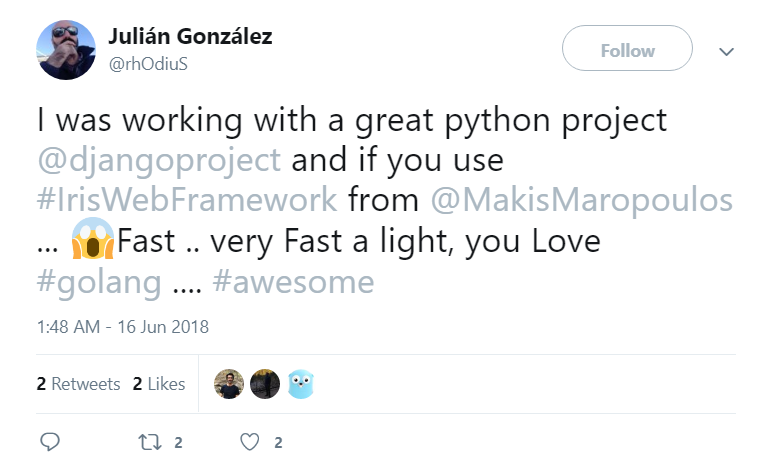
- Do you like the framework? Tweet something about it! The People have spoken:










 ### Get hired
There are many companies and start-ups looking for Go web developers with Iris experience as requirement, we are searching for you every day and we post those information via our [facebook page](https://www.facebook.com/iris.framework), like the page to get notified, we have already posted some of them.
### Author
### Get hired
There are many companies and start-ups looking for Go web developers with Iris experience as requirement, we are searching for you every day and we post those information via our [facebook page](https://www.facebook.com/iris.framework), like the page to get notified, we have already posted some of them.
### Author
 Gerasimos Maropoulos
|